

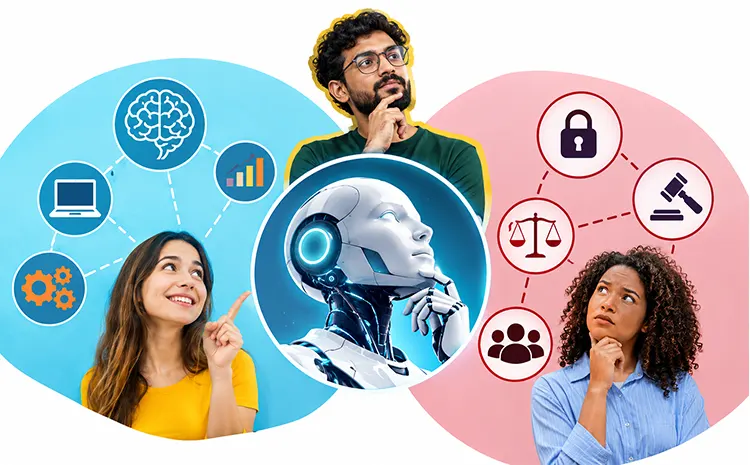

Artificial intelligence is really changing the way we do things. It’s used in lots of everyday stuff like voice assistants and systems that recommend things we might like. But AI is also used in business to automate tasks and look at data. So, what is artificial intelligence exactly? And how do companies use it? There are some challenges that businesses need to think about before they start using AI. This article will cover the basics of AI, what it’s used for, and some of the key problems companies might run into when they start using it.
What Is Artificial Intelligence?
Artificial intelligence (AI) is a subfield of computer science that deals with the automation of intelligent behavior. This includes machine learning, natural language processing (NLP), and deep learning, which is a specific method of machine learning.
The difficulty in defining intelligence lies in the fact that there is no precise definition. It can refer both to the human capacity for abstract and rational thought and the derivation of purposeful action and to the class of scientifically educated individuals. In psychology, however, intelligence is a collective term for mental capacity. Despite this ambiguity, research and development use the term.
The basic idea behind artificial intelligence is to use machines to approximate key functions of the human brain—learning, judgment, and problem-solving. One could also say that AI is an attempt to replicate human decision-making structures. For example, we achieve this by building and programming a computer to process problems relatively independently.
Examples of Artificial Intelligence in Everyday Life
We encounter AI quite frequently in everyday life: examples include biometric methods such as facial recognition, fingerprinting, or iris scanning to unlock smartphones, which are based on AI.
AI is also active on Facebook, Instagram, Twitter, and other platforms. It personalizes news feeds based on past behavior and retrieves friend suggestions. Furthermore, AI identifies and filters out fake news and spam and is used to combat cyberbullying.
The use of digital voice assistants is just as commonplace. They also work with artificial intelligence to answer questions or follow your commands using speech processing and generation. AI is also used in image recognition and reproduction, such as deepfaking.
Smart home products, smart office products, and other Internet of Things (IoT) devices are becoming increasingly popular. Blinds equipped with artificial intelligence open and close automatically depending on the amount of light, refrigerators notify smartphones which groceries are missing, and coffee machines start when the front door is opened.
One final example is streaming services. Anyone who uses them knows that Netflix, Amazon, Disney, and others suggest new movies and series based on previous streaming behavior. These services use natural artificial intelligence for this purpose.
How Is Artificial Intelligence Used in Companies?
Of course, artificial intelligence is not only used by individuals but also in companies. The ten largest companies that use AI in their businesses and are clearly pioneers are,
- The Chinese Amazon, the Alibaba Group
- Google’s parent company Alphabet, among others, with Google AI, TensorFlow, and GPT-3
- The e-commerce company Amazon
- Chinese technology company Baidu with its world’s second-largest search engine
- Social network Facebook
- Tech giant IBM, whose chess computer was smarter than chess world champion Garry Kasparov in 1997
- Software developer Microsoft
- Graphics card manufacturer Nvidia
- OpenAI, which started as a non-profit organization, and
- Chinese tech giant Tencent
Businesses are also adopting AI in data analysis to examine complex information, identify patterns, and make better decisions.
Police and other groups are using artificial intelligence too. Like, robot dogs can help out in bad situations or when a crime scene is too risky. But not everyone is happy about this. Some people think these robots can be used to watch us more closely and make the police stricter.
Using Chatbots as Artificial Intelligence
Companies are also using AI in the form of chatbots. These help, for example, with communication with potential customers on websites and provide alternatives to human customer service.
And these chatbots are relatively easy to implement, even for small companies. This is especially true in times of staff shortages, when it’s simply impossible to dedicate an employee to answering just the three, four, or five customer inquiries that come in through the website throughout the day.
It’s perfectly clear that artificial intelligence offers many opportunities, especially for small businesses. This principle applies to sales, production, and, of course, service. However, it’s crucial to approach it correctly to use AI effectively. The technology alone is no guarantee of success.
Four Key Challenges in Implementing Artificial Intelligence
Before a company can use artificial intelligence, it must overcome four hurdles:
1. Understanding Hurdles
Clarify what everyone understands by the term, from the CEO to the operational staff. Everyone must have the same level of understanding. Only then can ideas and expectations be clarified: Where should AI be applied? Where should it exhibit human-like behavior? Where is independent learning from feedback or mistakes desired? Where is intelligent data collection and enrichment necessary? Once these questions are answered, you can develop goals, strategies, and approaches.
2. Size Hurdle
Set clear goals. Break down overarching goals into sub-goals to see in which processes artificial intelligence (AI) makes sense. Having AI simply for the sake of having it benefits no one. One sub-goal could be ensuring your employees have precisely the knowledge they need. AI-based software platforms can help by delivering training directly at the workplace via smartphone, tablet, and smart glasses.
3. Data Hurdle
Before you start with artificial intelligence, check the data situation. AI can only work correctly with the right input. Look for application areas where enough data sets are available to train an algorithm. However, data quality is paramount. If you teach an AI nonsense, it will only produce rubbish.
4. Personnel Hurdle
Of course, you can seek external help if you want to implement AI in your company. However, model developers and data scientists are not only rare but also expensive. Furthermore, you can easily become dependent on them, which you should avoid. Cloud solutions that come with pre-built models are ideal. They require no specialized knowledge and are often ready to use in less than a week.
Invest in AI now, because it ‘s becoming increasingly important . But don’t overwhelm yourself or your employees!
Why IT Security Remains Important When Using AI
As mentioned earlier, artificial intelligence already surrounds us in many areas of daily life. Companies, too, will likely have to adopt AI in the long run. It simplifies many things when well-programmed. However, those inexperienced in the field of AI should first gain experience on a small scale before tackling larger projects.